Know the current SARON rate
The current SARON rate has become an essential benchmark for anyone looking to invest in real estate in Switzerland. Behind this indicator lies a strategic lever that directly influences the cost of a loan and the profitability of a project. Understanding how it works not only makes it possible to anticipate market fluctuations, but also to make more informed decisions.
 Yindee Becker ·
What is the current SARON rate and why is it important
The current SARON rate (Swiss Average Rate Overnight) corresponds to the rate at which Swiss banks lend money to each other in the very short term, generally for a period of one day.

Unlike older benchmarks such as LIBOR, SARON is based on actual transactions, which makes it more reliable and more transparent.
“SARON directly reflects the reality of the Swiss financial market.”
This rate is updated daily and serves as a basis for many loans, including variable-rate mortgages.
How does the SARON rate actually work in practice
The way SARON works may seem technical, but the idea is simple.
Rather than setting a single rate for several years, SARON changes continuously. Banks then use an average called Compounded SARON, calculated over a given period (often 3 months).

Then a banking margin is added.
Result: the final rate you pay depends directly on the current SARON rate + the bank’s margin.
Table of current SARON rates (real example)
| Date | SARON rate | ||||
|---|---|---|---|---|---|
| 18-03-2026 | 17-03-2026 | 16-03-2026 | 13-03-2026 | 12-03-2026 | 10-03-2026 |
| -0.046% | -0.045 % | -0.046 % | -0.046 % | -0.050% | -0.056 % |
This table clearly shows a trend: the current SARON rate remains very low, even negative.
This has a direct impact on real estate financing costs.
Why the SARON rate has a direct impact on real estate
When it comes to real estate investing, the interest rate is a key factor.
A low rate means:
- lower monthly payments
- a better borrowing capacity
- higher profitability
Conversely, an increase in SARON can quickly drive up the overall cost of a project.

It is precisely for this reason that many investors closely follow the current SARON rate.
SARON mortgage vs fixed rate: which should you choose?
The choice between a SARON mortgage and a fixed-rate mortgage depends above all on your strategy.
On one hand, SARON offers flexibility. On the other, the fixed rate provides security.
SARON mortgage
It follows the market directly. If rates go down, you benefit immediately. Conversely, if rates go up, your loan becomes more expensive.
Fixed-rate mortgage
The rate is fixed for several years. You know your monthly payments in advance, but you don’t benefit from any potential decreases.
Comparative table of mortgage rates in Switzerland
| Duration | Fixed rate Switzerland | ||
|---|---|---|---|
| 3 years | 5 years | 7 years | 10 years |
| from 1.24% | from 1.39% | from 1.54% | from 1.70% |
Compared with these rates, SARON often remains more advantageous in the short term, especially in a low interest rate environment.
An investment strategy tailored to the SARON rate
Investing without a strategy is a common mistake.
Some investors focus only on the property’s price, even though financing plays an equally important role.
“The real performance lever is often found in the financing, not in the asset itself.”
With proper analysis, it is possible to optimize:
the structure of the loan, the type of Swiss mortgage rate, and the timing of the investment.

It’s with this mindset that a solution like Ben Immo makes it possible to determine how much to invest, where to invest, and to connect directly with a suitable broker if you want to take action.
The central role of the mortgage in your project
In Switzerland, investing without taking out a mortgage is rare.
This mechanism makes it possible to use powerful leverage.

In practical terms, this means you can invest with limited capital while maximizing your return potential.
However, not all mortgages are the same.
Understanding mortgage financing in depth
Mortgage financing is about more than just a rate.
It encompasses several parameters:
the duration, the exit conditions, the conversion options, and above all the overall strategy.

For example, a SARON mortgage often allows you to switch to a fixed rate if the market develops unfavorably.
This flexibility is a major advantage in an uncertain environment.
The advantages of the current SARON rate
The main advantage of the current SARON rate lies in its ability to adapt to the market.
In a low interest rate environment, it allows you to benefit immediately from favorable conditions.
It also offers great flexibility, as it doesn’t require a long-term commitment like a fixed rate.
Finally, it often helps optimize the overall cost of the loan over several years.
The limitations to anticipate
However, it would be risky to look only at the advantages.
The SARON remains a variable rate, and therefore unpredictable.
A rapid increase can have a strong impact on your budget.
That’s why it’s essential to anticipate different scenarios and allow for a safety margin.
The factors that influence the SARON rate
The current SARON rate mainly depends on:
- decisions of the Swiss National Bank
- of inflation
- of the economic situation
- international financial markets
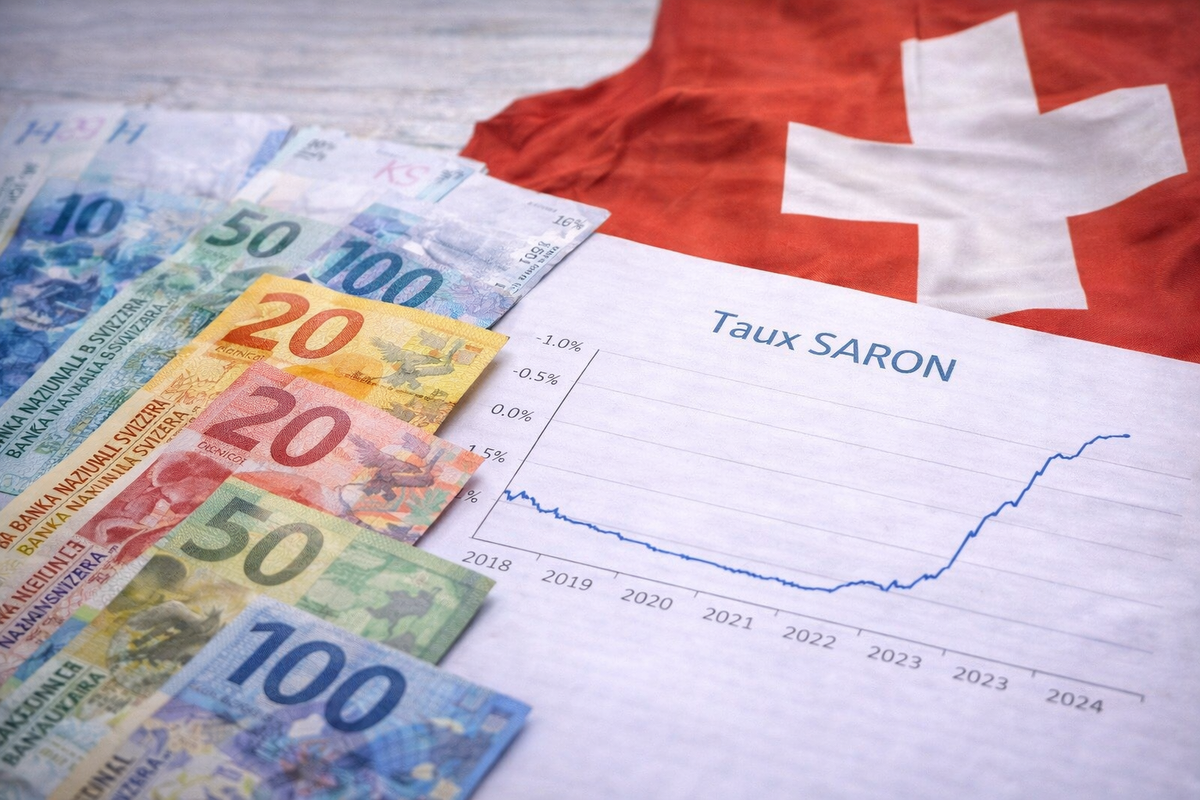
An accommodative monetary policy generally leads to low interest rates, while monetary tightening causes them to rise.
SARON rate forecasts and trends
Current forecasts indicate a certain short-term stability, remaining close to zero.
However, in the medium term, a gradual rebound remains possible.
This means that an investor must remain attentive and adaptable.
Why you should follow the SARON rate before investing
Ignoring the current SARON rate is like investing blindly.
This rate directly affects:
the cost of credit, profitability, and overall risk.
Good timing can make a significant difference over the course of several years.
Conclusion
The current SARON rate is much more than just a financial indicator.
It represents a strategic lever for any real estate investor in Switzerland.
By understanding how it works and what it implies, it becomes possible to optimize its financing and build a more effective strategy.
Ultimately, investing wisely isn’t just about choosing an asset, but about mastering all the factors that affect its profitability.