Becoming a homeowner in Switzerland without any equity
Becoming a homeowner in Switzerland without any personal funds may seem out of reach given the strict banking requirements. Yet with the right strategy and a solid understanding of financing mechanisms, this project becomes achievable. Between pension assets, guarantees, and financial structuring, several solutions now make it possible to overcome the lack of personal contribution.
 Yindee Becker ·
Understanding the rules for becoming a homeowner in Switzerland without own funds
First and foremost, it is essential to understand the framework imposed by Swiss banks.
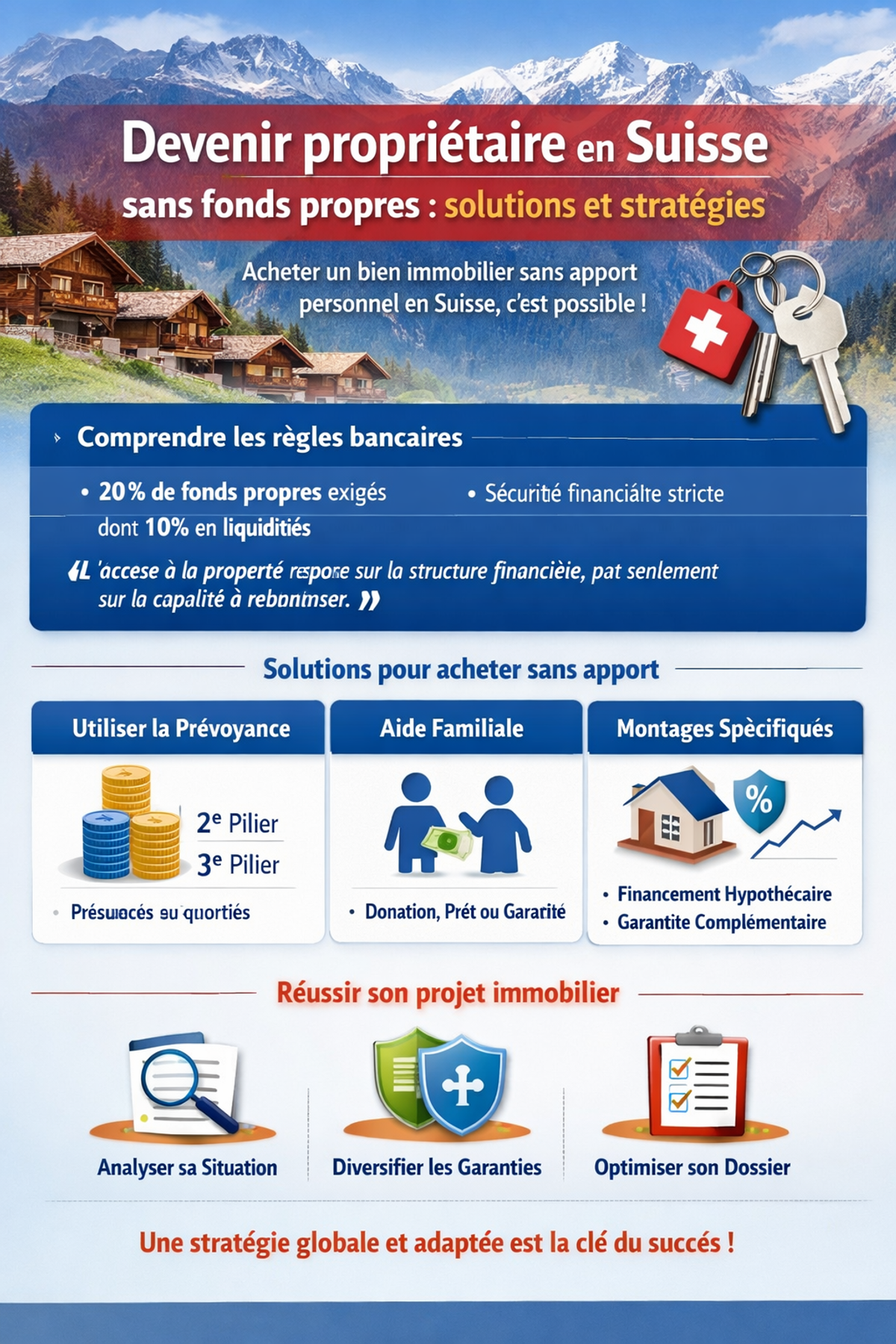
Traditionally, a buyer must have 20% in personal funds, including at least 10% in cash. This rule is intended to limit the risk of over-indebtedness and to safeguard the financial system.
However, this requirement is a major obstacle for many households.
“Access to home ownership in Switzerland depends more on the financial structure than on the ability to repay.”
Thus, even with a good income, the lack of savings can block a real estate project.
Why buying property with no down payment is difficult
The Swiss real estate market is particularly demanding.
On the one hand, prices are high, especially in urban areas. On the other hand, banks apply strict creditworthiness criteria.
This double bind explains why many give up on their project.
However, some alternatives make it possible to get around this restriction.
Ways to become a homeowner without a down payment
Use the 2nd pillar
The second pillar is one of the most commonly used levers.
There are two options:
- early withdrawal of funds
- pledged to the bank

Pledging is often preferred because it allows you to keep your pension rights while strengthening your application.
Using the 3rd pillar or insurance
The 3rd pillar can also be used as collateral.
Rather than withdrawing the funds, it is possible to pledge them as collateral. This reassures the bank without affecting your long-term savings.
This approach is part of an overall strategy for optimizing assets.
Family support as a lever
Support from a loved one can transform a case.
It can take different forms:
- direct donation
- advancement on inheritance
- structured family loan
In some cases, a relative can even act as guarantor, which greatly strengthens the credibility of the project.
A comprehensive financial strategy is essential
Becoming a homeowner in Switzerland without any equity is not based on a single solution, but on a smart financial arrangement.

It’s about combining several levers to meet banking requirements.
“It’s not the lack of input that holds you back, but the lack of strategy.”
It’s precisely with this in mind that a solution like Ben lets you analyze your situation, determine how much to invest, where to invest, and then connect directly to a broker if you want to move forward with your project.
The central role of the mortgage in your project
Access to home ownership inevitably involves a mortgage.
This mechanism makes it possible to finance up to 80% of the property, or even more in certain specific arrangements.
However, without equity capital, structuring becomes more complex.
The banks will then examine your file even more closely.
Understanding mortgage financing with no down payment
The mortgage financing without own funds is based on alternative collateral.
This may include:
- financial assets
- family benefits
- pension assets
In some cases, an additional loan may be considered, although this solution remains delicate.
Can multiple sources of funding be combined?
Yes, but it requires rigorous structuring.
Some strategies involve combining:
a primary mortgage loan, external collateral, and possibly additional financing.
However, banks remain cautious about this type of arrangement.
Banks’ acceptance criteria
Even without equity, banks apply strict rules.
Repayment capacity
The total payment should generally not exceed 33% of income.
This includes:
the mortgage, expenses, and any other possible debts.
Financial stability
A stable profile is essential.
Banks analyze:
the professional situation, the stability of income, and the overall management of the budget.
File quality
A strong application can make up for the lack of a down payment.
This includes a clear vision for the project, a coherent strategy, and credible safeguards.
Costs to anticipate
Buying without your own capital can lead to additional costs.
For example, acquisition costs must be financed in addition to the purchase price of the property.
Moreover, some banks apply stricter conditions or slightly higher margins.
The impact on investment profitability
Becoming a homeowner in Switzerland without any equity can be strategically advantageous.
Indeed, this makes it possible to:
preserve your capital, benefit from leverage, gain faster access to home ownership.
However, the cost of financing may be higher.
It is therefore crucial to strike the right balance in the project.
Mistakes to avoid
Certain mistakes can jeopardize your project.
For example, jumping in without preparation or without a detailed analysis of the financing.
Other investors underestimate banking constraints.
Finally, it is risky to take out multiple loans without an overall vision.
Why get support
In a project this complex, having support is a real asset.
An expert can:
optimize your financial plan, identify the best solutions, and secure your investment.
A long-term vision of wealth
Becoming a homeowner in Switzerland without personal funds should not be seen as a simple opportunity, but as a wealth-building strategy.
The goal is to build a sustainable asset.
This involves thinking about:
the valuation of the property, taxation and transfer
Becoming a homeowner in Switzerland without any equity is a challenge, but certainly not impossible.
With a structured approach, tailored solutions, and a comprehensive vision, it is entirely possible to become a homeowner without any initial savings.
Ultimately, this kind of project comes down to one thing above all: the quality of your financial strategy.